Battery Storage with a Heat Pump: 12 Months of Real Data from a UK Home
Why We’re Sharing Real-World Heat Pump & Battery Data
Battery storage is often discussed in theory — projected savings, estimated efficiencies, best-case scenarios. But for homeowners considering adding a battery to an existing heat pump system, the real question is simple:
What does this actually look like in a real home, over a full year?
To help answer that, we’re sharing 12 months of live performance data from a UK household using an air source heat pump, solar PV and battery storage — including heating, hot water, everyday electricity use and tariff optimisation.
This isn’t a new build or a “perfect” retrofit. It’s a realistic UK home.
The Property: A Typical, Imperfect UK Home
- 1950s dormer bungalow
- Solid walls with no external wall insulation
- Suspended timber floors (uninsulated)
- Loft insulation and double glazing
- Approx. 170 m², 4 bedrooms
- A mix of upgraded and original radiators
Why this home matters
This type of property is common across Cornwall, Devon, Somerset, Dorset and Gloucestershire — and often assumed to be “unsuitable” for heat pumps without major upgrades.
The Energy System
- Samsung 12kW Air source heat pump providing 100% of space heating and hot water
- 5kW Aiko Solar PV System
- 26 kWh Tesla Powerwall battery storage
- Time-of-use electricity tariff (Octopus GO from Octopus Energy)
- Weather-compensated control
- Minimum flow temperature: 35°C
- Maximum flow temperature: 55°C at 0°C outdoor temperature
On paper, this flow temperature range is not pushing absolute peak efficiency — which makes the results even more telling.
Annual Performance: The Key Numbers
| Metric | Annual Result |
|---|---|
| Heat pump electricity consumption | 4,104 kWh |
| Heat delivered (space heating + hot water) | 16,942 kWh |
| Average annual COP | ~4.1 |
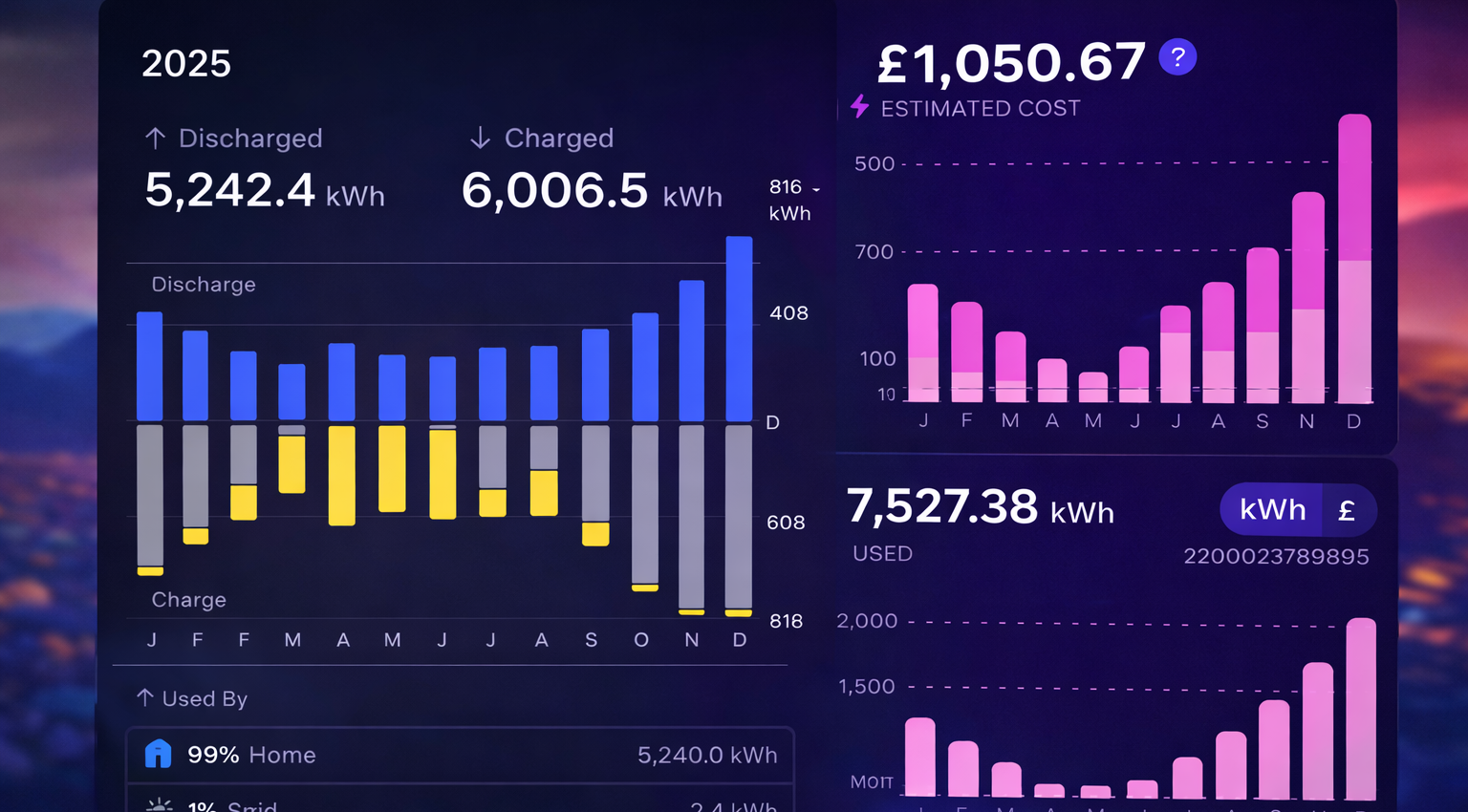
| Total household electricity consumption | 7,527 kWh |
| Total annual electricity cost | £1,050 |
| Effective average electricity cost | ~14 p/kWh |
| Electricity shifted via battery storage | ~3,900 kWh |
What These Numbers Mean
Heat Pump Performance
Over the year, the heat pump delivered more than four units of heat for every unit of electricity consumed, resulting in an average annual COP of approximately 4.1.
For a traditionally built, minimally insulated property running at moderate flow temperatures, this represents excellent real-world performance.
Electricity Costs in Context
The household consumed 7,527 kWh of electricity in total, covering:
- All space heating
- All hot water
- Cooking and general household use
- Low-level EV charging
The total annual electricity cost was £1,050, equating to an average unit cost of around 14 p/kWh.
For context, typical UK household electricity prices during 2025 were commonly in the region of 35–40 p/kWh on standard tariffs. Achieving an average cost significantly below this level was made possible by battery storage combined with a time-of-use tariff.
The Role of Battery Storage
Battery storage was central to the system’s performance and cost control.
Across the year:
- Approximately 3,900 kWh of electricity was imported at low-cost periods and stored in the battery
- That energy was later used to supply the home and heat pump during higher-priced daytime periods
- Peak-rate electricity imports were significantly reduced
This effectively shifted a large portion of energy consumption away from expensive periods, without affecting comfort or convenience.
Hot Water and Load Shifting
Hot water was produced using the heat pump during low-cost tariff windows and stored in the hot water cylinder for use throughout the day.
Everyday household appliances were used normally, with some load shifting taking place where practical. Importantly, the system did not rely on extreme behavioural changes — the savings came primarily from system design and storage, not lifestyle compromise.
What This Example Shows
This real-world data demonstrates that:
- Battery storage works extremely well alongside heat pumps, not just with solar PV
- Even in older, less efficient homes, intelligent energy management can deliver strong results
- Time-of-use tariffs unlock far more value when paired with battery storage
- Heat pump running costs can be kept low without pushing systems to their absolute efficiency limits
For existing heat pump owners, battery storage is often the single most impactful upgrade available.
Could This Work for Your Home?
Every home is different — but many properties across the South West share similar characteristics to this one.
At GreenGenUK, we design battery storage systems specifically for existing heat pump homes, taking into account:
- Your current heat pump and controls
- Electricity usage patterns
- Tariff options
- The correct battery capacity
- Opportunities for load shifting
If you already have a heat pump and want to reduce running costs while future-proofing your home energy system, battery storage is well worth considering.
👉 Book a free, no-obligation assessment with GreenGenUK today.
In our next article, we’ll explain why battery storage has become the smart next upgrade for heat pump homes, including how time-of-use tariffs and load shifting work — and who benefits most.


A Partner You Can Trust